Report: Dangerous Chemical May Have Caused Maersk Honam Fire
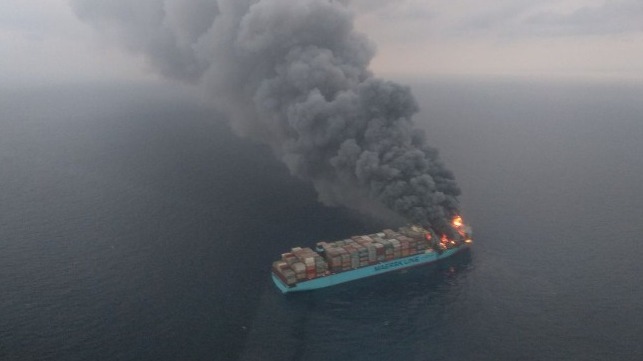
Singapore's Transport Safety Investigation Bureau has concluded its inquiry into the deadly fire aboard the boxship Maersk Honam in 2018. While the bureau was not able to conclusively determine the cause, its forensic investigators ruled out electrical faults, fuel tank heating, misdeclared goods and non-IMDG cargo ignition sources, leaving one possibility: a giant block stow of an oxidizing compound called sodium dichloroisocyanurate dihydrate (SDID).
SDID is a chlorinating agent classified as an IMDG Class 9 miscellaneous dangerous good – not as a more dangerous Class 5.1 oxidizer. However, it is highly oxidizing and has the potential for self-decomposition when stowed in bulk, much like the notorious self-heating compound calcium hypochlorite, which is used for identical end purposes.
When Maersk Honam set sail, a total of 1,000 tonnes of SDID was stowed in a cube-shaped stack of 54 containers in her number-three cargo hold, the location where the fire broke out. The stow was fully compliant, and Maersk's cargo-loading program detected no issues with the arrangement when it was placed on board.
At 1945 hours on March 6, 2018, while she was under way off the coast of Oman, a smoke alarm went off in her number three hold. The master headed for the bridge, and on the way up he smelled chlorine, though he saw no smoke. At 1951 hours, he instructed the chief mate to sound the fire alarm, and the crew mustered for a response. The crew's firefighting teams managed to shut off most of the vents around the hatch for the number three hold, but they could not seal off 16 natural ventilation flaps on the port side. Even though the vents were not fully closed, the master ordered the use of the CO2 flooding system in an attempt to extinguish the blaze.
At 2035 hours, with the smoke worsening, the master ordered all crew to muster on the bridge. He ordered two more rounds of CO2 flooding, including a full discharge on the final round. The last discharge was followed by several explosions and a large plume of smoke, which engulfed the accommodations block and led most of the crew to flee the bridge in panic. They separated into four groups, and each separately made its way aft to abandon ship. The 23 survivors were rescued by the boxship ALS Ceres; one of them – the ship's painter – died of his injuries before reaching shore.
During rescue and salvage operations, the bodies of two deceased crewmembers were found on the port side bridge wing, where they had been using fire hoses to assist with boundary cooling. One more was found below the port side lifeboat. The final missing crewmember was not found.
Throughout the firefighting and abandon-ship evolutions, the crew reported that they encountered "white colored smoke with strong bleach/chemical smell," and they experienced breathing difficulty and skin irritation. A blue Maersk uniform recovered from the ship was bleached nearly white, and firefighting gear showed extensive bleaching discoloration.
The investigators noted that this evidence would be consistent with exposure to the decomposition products of SDID. As the compound overheats and decomposes, it produces white smoke and chlorine gas. Its combustion results in the release of additional hazardous compounds, potentially including trichloramine, cyanogen chloride and phosgene, a deadly gas.
Recommendations
Singapore's Transport Safety Investigation Bureau recommended several regulatory revisions to reduce the odds of a similar casualty, including:
– Requiring temperature sensors in cargo holds connected to the ship's fire detection system;
– Employing specially-designed cargo containers for IMDG goods, fitted with appropriate internal firefighting equipment that would self-activate in the event that the temperature in the container went too high;
– Reviewing the proper classification of SDID within the IMDG Code;
– Calling on carriers to treat SDID in the same way that they handle calcium hypochlorite – stowed on deck and away from sunlight;
– Reviewing SOLAS firefighting standards for boxships to address the risk of cargo hold fires.
maritime-executive