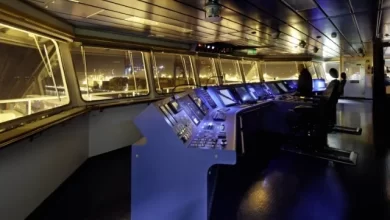
On Watch: International Coalition Monitors, Protects Middle East Shipping Lanes
The International Maritime Security Construct (IMSC) was created July 2019 as a way to deter unprofessional behavior in the waters of the Middle East region through its operational arm, Coalition Task Force (CTF) Sentinel.
The IMSC comprises eight nations – Albania, Australia, Bahrain, Saudi Arabia, Lithuania, United Arab Emirates, United Kingdom and United States – who deploy personnel, ships and aircraft throughout the region as part of the international surveillance and detection effort.
Since establishing CTF Sentinel, the focus has been on building presence within the Arabian Gulf, Strait of Hormuz, Gulf of Oman, Gulf of Aden, Bab el-Mandeb Strait and Southern Red Sea. Reassurance to legitimate mariners within the commercial shipping community is paramount.
Commercial shipping transits regularly through the Strait of Hormuz, with approximately one sixth of global oil production and one third of the world’s liquefied natural gas channeled through this chokepoint each year. The Bab el-Mandeb Strait, another significant maritime chokepoint, sees approximately 17,000 merchant ships pass through annually.
“Sentries” and “Sentinels” are placed strategically throughout the region to provide constant overwatch and deter unlawful, unsafe or unprofessional activities. Sentries are smaller naval platforms such as corvettes and patrol vessels while Sentinels are larger naval platforms such as frigates and destroyers.
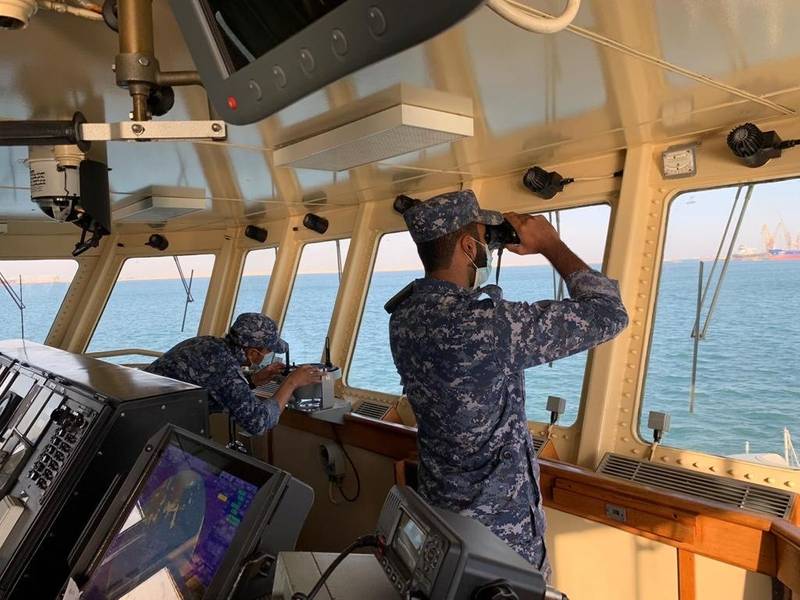
The Royal Bahrain Naval Force (RBNF), a regional partner, patrols Bahrain’s territorial waters contributing to the IMSC mission. RBNS Al Muharraq is a corvette patrol craft assigned to CTF Sentinel as a Sentry ship.
“This mission is important for shipping companies,” said Commander Khaled Mubarak Isa Bin Hindi, captain of RBNS Al Muharraq. “We want them to feel safe when they transit the Gulf. This region is important to global trade, so if our presence provides stability and reassurance to the people who operate tankers and cargo ships, then we shall remain vigilant and dutiful to the IMSC.”
“We know these waters well,” said Bin Hindi. “Bahrain’s waters are home to the RBNF giving us an operational advantage we share with IMSC coalition members. Together, we are stronger, safer.”
The guided-missile destroyer USS Paul Hamilton (DDG 60) transits the Strait of Hormuz transit aboard Aug. 30, 2020. Paul Hamilton is deployed to the U.S. 5th Fleet area of operations in support of naval operations to ensure maritime stability and security in the Central Region, connecting the Mediterranean and Pacific through the Western Indian Ocean and three critical chokepoints to the free flow of global commerce. (U.S. Navy photo by Mass Communication Specialist 3rd Class Matthew F. Jackson)
“One of the major advantages of IMSC is that we have this strong relationship with regional nations who belong to the coalition,” said CTF Sentinel Commander, Royal Navy Cdre. Rob Bellfield. “This provides shared awareness of activities across the region which strengthens our interoperability and coordination to deter actions that put merchant mariners at risk.”
Bellfield assumed command of Bahrain-based CTF Sentinel, April 30, providing new direction and vision for the IMSC. Having previously served as deputy commander for all Royal Navy maritime operations in the Gulf region and Middle East, he worked closely with U.S. 5th Fleet staff to integrate U.K. and U.S. Navy warfighting capability from 2013-2014.
“I have served more than 30 years – much of it at sea or in supporting operations – which has helped me develop a keen insight into the merchant maritime community particularly in this region that is vital to international trade,” said Bellfield. “Ensuring the free flow of international commerce is our top priority and we do this through the three tenets of our mission: vigilance, surveillance, and assurance.”
Coalition warships regularly patrol the waters in the Middle East region, supporting a variety of tasks.
While the coalition Sentinel and Sentry ships are on patrol, they observe the pattern of maritime traffic and monitor for malign activity.
maritime professional