
Fifteen global shipping companies slowed cargo ships off California coast to protect blue whales and blue skies
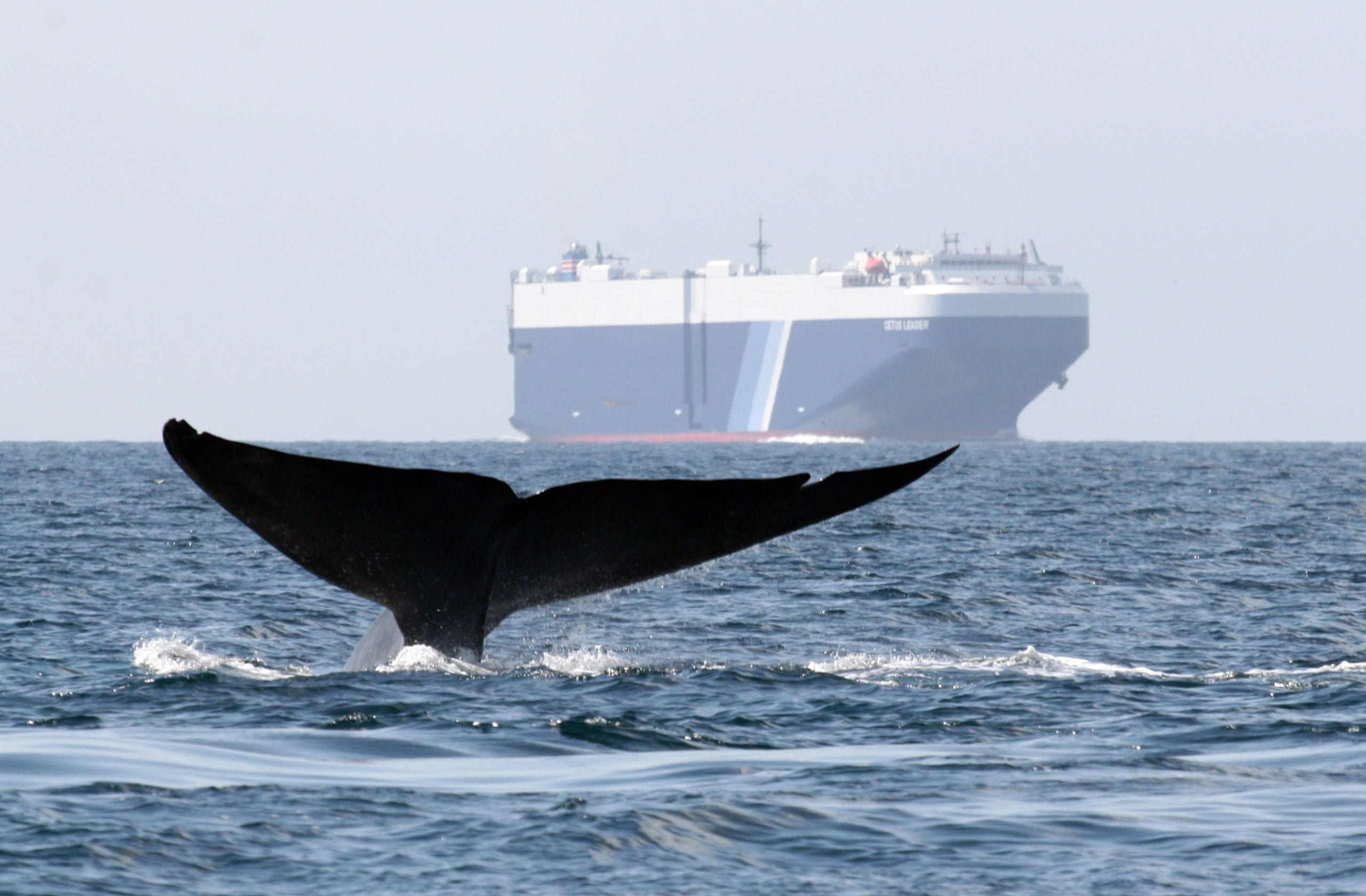
The partners in an initiative to cut air pollution and protect endangered whales announced results from the 2019 program and recognized the 15 shipping companies that participated, reducing speeds to 10 knots or less in the San Francisco Bay Area and the Santa Barbara Channel region. The voluntary incentive program ran May 15, 2019 through November 15, 2019. Partners hope to further recognize the companies at a ceremony at the Port of Hueneme later this year, depending on public health guidelines regarding the COVID-19 pandemic.
Shipping companies receive recognition and financial awards based on the percent of distance traveled by their vessels through the Vessel Speed Reduction (VSR) zones at 10 knots or less and with an average speed of 12 knots or less. (The average baseline speed of participating ships prior to the incentive program is approximately 15 knots in the VSR zones.) The 10-knot target follows the National Oceanic and Atmospheric Administration’s (NOAA) requests for all vessels (300 gross tons or larger) to slow down during the months of peak endangered blue, humpback, and fin whale abundance to protect these whales from deadly ship strikes.
NOAA has identified ship strikes as a leading cause of death; reducing these mortalities is a major priority of NOAA’s, including NOAA’s West Coast national marine sanctuaries. Documented deaths totaled 48 endangered whales from 2007-2019, and likely represent only a small fraction of the total number of ship strikes annually.
The timing of the program also coincides with the season when ground-level ozone (smog) concentrations are typically high. The 10-knot target allows ships to travel at an efficient operating load using less fuel and producing less pollution. Ocean-going vessels transiting the California coast generate nitrogen oxides (NOx, a precursor to smog), sulfur oxides (SOx), particle pollution, and greenhouse gases. These vessels account for more than 200 tons of NOx per day emitted off the coast of California, which affects ozone levels onshore in many regions of the state. The greater Los Angeles area (including Ventura County), San Diego, and San Francisco Bay areas do not meet the state and/or federal air quality standards for ozone.
The program is a collaborative effort by the following agencies and organizations:
The program partners established four award tiers to recognize participating companies based on the percent of distance their fleet traveled through the VSR zones at speeds of 10 knots or less. The four award tiers are Sapphire (75-100% of fleet total distance in Vessel Speed Reduction (VSR) zones traveled at 10 knots or less), Gold (50-74%), Silver (25-49%), and Bronze (10-24%). Automatic Identification System (AIS) transponders on each ship continuously transmitted the ship’s speed, heading, and location. AIS data was analyzed for each fleet and the company’s performance was classified by tier. Companies that performed at Gold or Sapphire level were awarded a financial incentive.
Shipping companies in the Sapphire tier included Mediterranean Shipping Company, Hapag-Lloyd, Polynesia Line and Gali. Gold included CMA CGM, NYK Line, Pacific International Lines, COSCO shipping, Evergreen, Maersk Line, and K Line. Silver awards went to Yang Ming and Hyundai Glovis, and Bronze went to Ocean Network Express and Matson.
The Mediterranean Shipping Company and Hapag-Lloyd notably achieved the Sapphire tier in the large company category (greater than 30 transits) in both regions by slowing down more than 400 transits, combined. Polynesia Line and GALI achieved the Sapphire tier in the small company category (less than 30 transits) in both regions. For their outstanding commitment, all four of these companies earned the Protecting Blue Whales and Blue Skies Whale Tail award.

The VSR incentive program has expanded in scope and environmental benefits each year, including 2019, which marked the fifth year. Highlights of the 2019 program include:

Partners weigh in on the program:
“Thanks to a Supplemental Environmental Project award from the California Air Resources Board, the 2019 incentive program demonstrates that stable funding for the fleet-wide incentives can achieve great benefits for air quality in the region. Ventura County had one of the cleanest ozone seasons in modern history in 2019 and the reduced nitrogen oxides emissions from shipping in the Channel was certainly a contributing factor. The continued implementation of the voluntary vessel speed reduction incentive program is crucial for Ventura County to meet the 2008 federal air quality standard for ozone by our statutory deadline of 2021.”
– Dr. Laki Tisopulos, Air Pollution Control Officer, Ventura County Air Pollution Control District
“The 2019 Vessel Speed Reduction Incentive Program was our most successful year to date. With an increase in participating companies and a doubling of nautical miles slowed, the program achieved the largest emission reductions to date — twice as much ozone precursor and greenhouse gases reduced as compared to 2018. This is a great example of a successful collaboration of local, state, national, and international organizations coming together to protect endangered whales and improve air quality off our coast.”
– Aeron Arlin Genet, Air Pollution Control Officer, Santa Barbara County Air Pollution Control District
“When public, private, and non-profit organizations work together, we can improve public health as well as the environment. Both air quality and blue whales benefit by the slower movement of ships through critical coastal zones.”
gCaptain


