In Beirut Port, All of Lebanon’s Ills Are Laid Bare
The first of many warnings about a deadly cargo in Beirut’s port came in February 2014, about three months after its arrival. It was made by Colonel Joseph Skaf, described by his family as a diligent customs official.
Skaf, then the head of the anti-narcotics and money laundering division, informed the customs authority that the shipment of ammonium nitrate was “extremely dangerous” and posed a risk to the public.
In his handwritten letter, reviewed by Reuters and authenticated by a source familiar with the case, he urged that the ship, the Rhosus, be “moved away from the pier to the breakwater and if possible put under surveillance.”
Reuters couldn’t determine whether Skaf, who died in 2017, received a response to his letter or whether he followed up on his warning. The office of the customs director referred questions about the matter to the finance ministry. The ministry didn’t respond.
Skaf’s brother Elie recalls the colonel saying of the cargo, in 2014: “We will refuse to let them unload it.” Skaf’s son Michel says his father’s determination to keep the Rhosus out of the port was typical of a man who “didn’t let things pass” and challenged the wrongs he saw.
Skaf’s letter, dated Feb. 21, 2014, was the first of several warnings by port, customs and security officials about the ammonium nitrate on board the Rhosus. None were acted on.
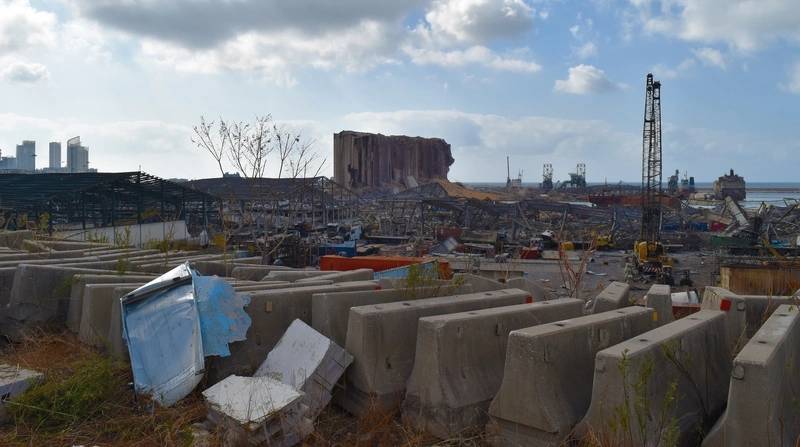
Skaf moved a few months later to a new job overseeing airport customs. Shortly afterwards, in late 2014, the Rhosus’ cargo was transferred to a dockside warehouse. It exploded on August 4 this year, destroying whole neighborhoods and killing nearly 200 people.
For the people of Lebanon, the wreckage of the port, and the failure to heed the warnings of Skaf and others, has a wider symbolism. Nearly three months on from the blast, they are still waiting for the results of an investigation their leaders promised would reveal the truth within days. Efforts to form a new, non-partisan government foundered on Lebanon’s sectarian politics. In this chaos, international aid money, contingent on a new government stamping out corruption, has yet to flow.
Skaf’s family believes his death in 2017 was murder, possibly connected to his long career as a customs officer fighting criminality and drug smuggling, or his recent entry into politics. The official medical report, produced in 2017, found Skaf died in a fall. A second report, commissioned by the family, concluded in 2018 that Skaf was attacked.
Corruption beyond imagination
The port, one of the busiest in the eastern Mediterranean, handling an estimated $15 billion of trade a year at its height, was rife with corruption, negligence and sectarian politics, according to nine people involved in shipping, clearance and administration. Their accounts were buttressed by import documents that one of the sources showed to Reuters.
The port mirrored the country at large, with jobs shared out along sectarian lines among mainly Muslim and Christian groups. It’s an arrangement that has governed Lebanon over the past three decades, and is blamed by many for plunging the country into financial ruin.
As one senior minister told Reuters: “The level of corruption in all layers of the state is beyond imagination. How much more corruption, like the port, is hidden beneath the cloaks of politicians?” He said he has received threats warning him “not to dig into corruption.” He didn’t elaborate.
After Lebanon’s 1975-1990 civil war, a transitional committee, representing the main sectarian political groups, was formed to manage Beirut’s port temporarily. The committee remains to this day.
Port chief Hassan Koraytem is widely seen as a loyalist of Prime Minister Saad al-Hariri, a Sunni Muslim, while customs boss Badri Daher’s nomination was backed by Christian President Michel Aoun’s party.
maritime professional