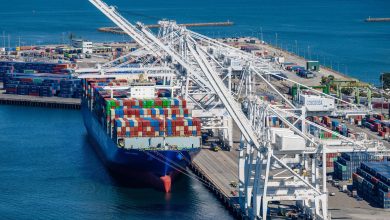
Congestion Looms at U.S. Ports

As retail outlets, as well as many manufacturing operations, in North America are shuttered, anticipation of a surge of imports to compensate for China’s extended lunar new year hiatus are quickly disappearing.
Instead, as more containers arrive, there are concerns about mounting storage costs.
US importers have not wasted time in shifting gear – having tried to speed-up deliveries from China a few weeks ago, they are now in reverse, trying to slow down imports, or cancel them outright.
“Importers are cancelling orders left and right,” said Cathy Morrow Roberson, head analyst and founder of Logistics Trends & Insights.
Others, she added, were deferring shipments or looking to extend transit times, all in marked contrast to the recent rush to bring in goods from China.
“There’s a mix of cancellation and deferment. It depends how much inventory they have on hand and how much they expect to draw down,” Ms Roberson said.
Bob Imbriani, senior vice-president international of Team Worldwide, said some companies could not cancel orders, so deferment was their only option for mitigation.
Elio Levy, executive vice-president of Logfret, added: “What they do is between the importers and their suppliers. They don’t involve us, but we see volumes are down. We have orders, but not as many as expected.”
This tallies with reports of some cargo terminals at US ports slowing operations as imports decline.
“While some terminals are working normal hours, others have reduced hours or are closed for one-to-two days a week,” reported Crane Worldwide Logistics yesterday.
Auto makers have also been delaying orders, Mr Imbriani noted. With factories closed in response to the pandemic, they have no need for parts at their North American assembly lines.
A lot of manufacturing is idling, said Ms Roberson, and she does not expect the sector to get going again until the summer – and that may be optimistic, she added.
And for the retail sector a return to pre-Covid-19 activity looks even more elusive, Ms Roberson said, adding that she won’t be surprised if a lot of retailers don’t survive the crisis.
Another forwarder suggested the retail sector was showing signs of weakness before the pandemic.
The paralysis of factories and stores has led to concerns that the wave of imports set to hit US ports could cause huge congestion. Manufacturers and retailers are reportedly not picking up cargo from ports, evoking the spectre of terminals – many already sitting on large numbers of empty containers – clogging up.
These worries are reinforced by reports of increased demand for storage space in warehousing facilities.
“There is big demand for storage. A number of clients brought in goods to be put into production, now they’re sitting almost as dead storage,” Mr Imbriani said.
gCaptain