Chinese Demand Keeping the Dry Bulk Market Going -BIMCO

An impressive recovery in Chinese dry bulk imports has protected the industry from the effects of falling demand in the rest of the world. High deliveries and low contracting have left the orderbook at multi-year lows, but – with the poor outlook – the current influx of new dry bulk ships orders is not what is needed.
Demand drivers and freight rates
The biggest story in the dry bulk industry in recent months has been the strength of the recovery in major Chinese imports. These are up across the board, breaking previous records, not just for monthly imports, but also accumulated over the first seven months of the year. The Chinese recovery has been strong enough to make up for lower activity in the rest of the world, with all ship sizes above their break-even levels.
Capesize earnings rose quickly in late June, to reach $33,760 per day on July 7. The high Chinese imports led to congestion at many of its ports, temporarily lowering the number of available ships. Since then, rates have fallen to a more sustainable level, averaging around $19,400 per day in August.
In particular, Chinese iron ore imports have been strong and are up 11.8% in the first seven months of this year compared with last – an additional 348 Capesize loads (200,000 tonnes). At 112.6 million tonnes, imports in July were at a record high, bringing total imports in the first seven months of the year to 659.6 million tonnes.
Higher steel production levels are, in part, behind the higher iron ore imports. Stimulus measures from the Chinese government are prompting local governments to invest in infrastructure projects, encouraging steel production. After monthly declines in March and April, Chinese crude steel production has recovered and, after seven months, is up by 2.8%.
The rise in steel production in China comes at the same time as production is falling in the rest of the world (-16.5% year-on-year), as the recovery elsewhere lags behind. This development means that, in Q2, China accounted for a record high 62% of global steel output, up from 54% in 2019. EU steel production was down 24.4% in July from last year, drops largely driven by the collapse of many manufacturing sectors, in particular Germany’s car production.
The high iron ore imports come after a few years in which Chinese steel production (+8.3% in 2019 and +6.6% in 2018) has grown faster than its iron ore imports, as it has moved towards using more electric arc furnaces and scrap steel, rather than blast furnaces. Looking at the whole picture, the higher steel production and infrastructure investment cannot fully explain the rise in iron ore imports and much of it will make its way into stockpiles.
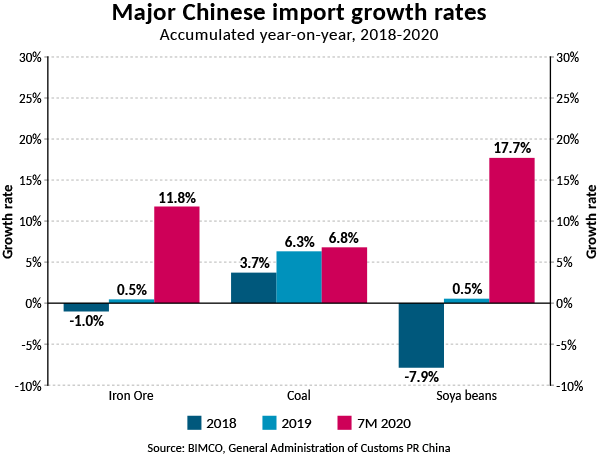
In contrast to Chinese iron ore imports, which have grown throughout the year, coal imports did not grow in Q2. Since April, monthly coal imports have been below the corresponding month in 2019. In July, imports were 6.8 million tonnes lower this year than last. The strong start to the year – boosted by cargoes arriving at the end of 2019 but only clearing customs in January and February because of local restrictions – means that, despite the fall in Q2, accumulated year-on-year growth is still up by 6.8% in the first seven months of the year.
Lower electricity demand as a result of the pandemic has caused U.S. coal production to fall. In the week of 29 August, U.S. coal production stood at 11.1 million metric tons, 26.7% lower than the same week last year. Year to date, U.S. coal production is down 26.9% from last year. The Energy Information Administration (EIA) expects that, over the full year, U.S. exports of metallurgical coal will fall by 32.3%, to 37.3 million tonnes, and thermal coal exports will drop by 30.2%, to 26.3 million tonnes. In total, the drop in U.S. coal exports would mean a loss of 319 Capesize loads (200,000 tonnes).
Iron ore and coal trades provide demand mainly for Capesize ships, while the smaller ships – in particular, Panamaxes and Supramaxes – have experienced higher demand because of strong agricultural exports. Brazilian soya bean exports have been at a record high this year. So far, they are up 36.3%, at 69.8 million tonnes. Compared with last year, this is an increase of 248 Panamax loads (75,000 tonnes), three-quarters of which sailed across the world to China.
These strong agricultural exports have helped drive Panamax earnings up to $15,815 per day on 19 August, and Supramax earnings to $10,494 per day.
Fleet news
The dry bulk fleet has seen both deliveries and demolitions rise over the course of the pandemic, while contracting has fallen steeply. So far this year, the dry bulk fleet has grown by 2.8% and breached 900 million dead weight tonnes (DWT) for the first time. Currently at 903.3 million DWT, BIMCO expects full-year growth to reach 3.5%. On the other hand, the orderbook has fallen to 63.4 million DWT, its lowest level since April 2004.
maritime professional