Business of Shipping: LNG Carriers Face Less Volatile Market Than Crude Tanker Peers
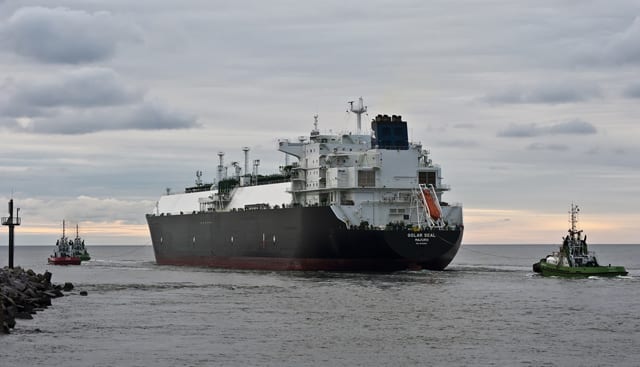
That’s largely due to major differences in how the commodities are traded, transported and consumed, according to analysts and industry experts.
The different LNG/crude oil market dynamics have been playing out in their respective waterborne-transport sectors since producers of both feedstocks, about six weeks ago, began flooding markets. The excess output resulted from the Covid-19 induced-demand downturn.
Most LNG is purchased under long-term, “take or pay” contracts that allow shippers to defer delivery, usually within the 12-month contract term, under an “annual contract quantity” clause.
However, “take or pay (purchase) contracts” generally don’t allow deferred payment.
To defer delivery, consignees must give the carrier at least 60 days advance notice, as required in LNG carrier fixed-price, long-term time charters. Those charters, twinned with the “take or pay” contracts, govern the employment of most of the 504 or so LNG ships operating worldwide.
And those purchase contracts likely haven’t been breached, said Thomas Burgess, a co-founder of Pointe LNG.
Pointe LNG is a LNG supercooling/marine transfer facility being developed in Pointe a la Hache, LA, about 50 miles south of New Orleans.
The standard agreement to charter LNG carriers effectively shields those ships from market volatility, reported Teekay LNG Partners, which operates 48 LNG carriers in a recent corporate filling.
Under LNG-fixed rate (carriage) contracts, “customers pay full hire (fees) to Teekay LNG regardless of their usage of the vessel,” Teekay reported.
And most of the Teekay fleet enjoys such rate protection. In fact, Teekay, in an April 3 press release, noted that “our fleet is 98 percent fixed (chartered) through 2020 and 94 percent fixed in 2021.”
The upshot: Teekay maintains it “is not impacted by LNG prices or structural or global imbalances of LNG.”
However, contractual shipping commitments are not stopping LNG charterers from canceling voyages from the US Gulf Coast to western Europe given the recent, sharp demand drop off. The number of weekly sailings declined in April on this route by about 12.5 percent, from an average of 16 to 14, representing about eight lost cargoes, said Jefferson Clarke, a Poten & Partners analyst based in Houston.
He is one of several analysts from Poten, a New York-based consultant, who spoke during a series of company webcasts earlier this month.
And LNG charterers have canceled at least 25 cargo shipments, in both May and June, from the US Gulf coast to western Europe, said Houston-based Jason Feer, head of Poten’s Global Business Intelligence unit
Those “cancelations and deferrals in the US have been able to keep the (overall) market functioning,” Feer said Wednesday.
Moreover, additional shipments of US Gulf to western Europe cargoes will be canceled through September, Feer added.
“Europe is the market of last resort for cheap (LNG) gas,” he said.
gCaptain