Will 5G change logistics and ports?
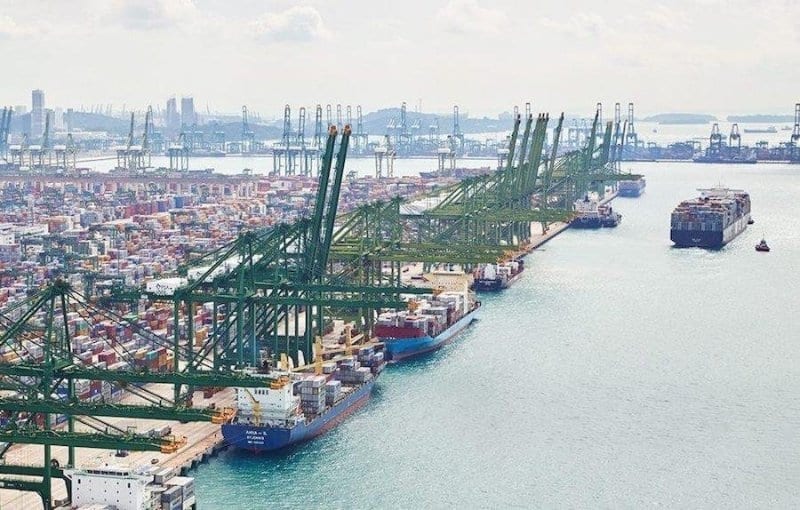
The recent conference and summit circuit in Singapore has had a strong focus on technology and how it will forever change the way we conduct our lives. With the Smart Maritime Network summit, I note that the debate has shifted from concept to the development of smart port technology. This is an important discussion to have, particularly as many ports move towards a form of automation and smart port design to remain competitive in a crowded maritime market. This is particularly important as Singapore’s Tuas port progresses towards being a transhipment smart port competing with many other ports in the region.
To date, development of smart port technology has focused on what can be done within current digital and technological limitations. There has not been much discussed as to how the introduction of 5G on smart port development will change the shape of shipping, logistics, supply chain and production. Whilst the general public associates 5G with virtual reality and online gaming applications of the new technology, the important issues such as cyber security, IP and privacy concerns are being discussed by political and business leaders.
Much of the debate centres around who / what will control the data as well as access to that data. Central to the debate is the role 5G providers such as Huawei and China’s progress in the application of 5G to areas outside of the gaming world. Some would argue that the US has stirred up the debate around privacy issues and cybersecurity as a reason to delay the implementation of 5G. It can be argued that this was designed to give the US time to play catch up to other countries that are ahead of the 5G game.
So, what is 5G?
The best way to describe 5G is that it moves our world closer to harnessing the Internet of Things (IoT). It is an enabling technology that not only connects people but objects, such as the things we own.
How does 5G change logistics and port management?
Current port and logistics systems are limited by the amount of data / information sharing capability with current technology. They rely on a combination of fibre optic cable for connectivity augmented by 4G. Unfortunately, this does not have the bandwidth, latency or capacity to carry the level of data required to drive the likes of automation. There are three central elements that gives 5G an advantage over existing platforms, namely: data density, transfer speeds and latency. In simple terms, 5G can support a million sensor devices per square kilometre as opposed to 4G’s 100,000 devices. Furthermore, it transfers data (latency) between devices at one millisecond, with 4G at 50 milliseconds, giving a more accurate measure of “real time” monitoring. Combined these with the capacity to connect equipment to equipment via data and visual sensors enables smart decision making.
5G now allows companies to deal with the 100m to 120m data points from different sources daily. These sources include ports, vessel movements, containers etc. Importantly, in an ultra-dense shipboard environment, 5G extends connectivity to thousands of sensors within a confined area. With the proliferation of base stations connected by satellite, it enables seamless ship-land communication that optimises port operations, such as offloading / onloading vessels. China has taken a leading role in this, evidenced by it rolling out of 200,000 5G base stations that connect via satellite communications.
Furthermore, data and information allow complete visibility of cargo in transit. By allowing real time monitoring of goods in transit it can remotely manage them. It not only gives details as to location, but can give updates on temperature, humidity, “g” forces etc on goods in transit. The net result is an optimised supply chain as the data allows carriers to streamline complex intermodal processes. By always being “on” it will give accurate data to substantiate responsibility for the cargo and ownership, particularly when corrective action needs to be taken or insurance claims are made.
Ports and their authorities have recognised the role of 5G in progressing true smart ports and the potential that IoT has for automation and augmented reality applications. These applications will improve efficiency and optimise logistics supply chain and port operations. There are several ports currently investigating 5G applications. These include the ports of Rotterdam, Qingdao, Hamburg as well as Singapore.
Rather than describing all these applications, it is best to look at a couple of examples of what is currently being investigated.
China is leveraging 5G to foster development of what they call intelligent port centralisation, a move towards full automation of container terminals to reduce costs and improve efficiency. Centralisation allows port activities to be operated remotely and from a central location, such as is already the case in Australia’s mining sector with iron ore dump trucks. For this to happen, the port requires low latency, large bandwidth and high reliability, all of which is offered by 5G. They are currently pursuing this in the ports of Xiamen, Qingdao and the Yangshan deep water port in Shanghai, with Qingdao being the first to apply 5G technology to port operations.
splash247