62 People Were Injured in Failed Gaza Floating Pier Mission Last Year
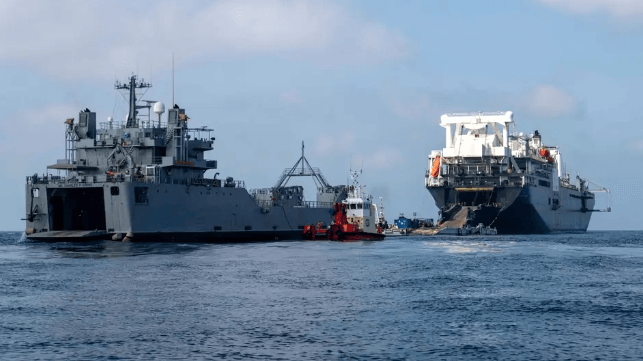
The Gaza floating-pier mission was even more fraught than previously reported, according to a new investigation by the Pentagon's independent inspector general's office. In addition to the servicemember who was killed in an accident during cargo operations, 62 people were injured in unspecified incidents.
Most of the problems were built into the operation before it got under way. The IG found that the Army and Navy had systematically downsized their joint logistics over the shore (JLOTS) capabilities since 2018, leaving remaining units undermanned and underequipped for the mission. The Army had cut its watercraft division's inventory from 134 vessels down to 64, and the Navy had eliminated one of its two JLOTS units. Officials involved in the deployment told the IG after the fact that "the DoD's current JLOTS capabilities were not sufficient to meet projected needs." In addition, the Army and Navy pontoon systems were different and resulted in damage when used together; they were designed with different amounts of freeboard, and Army boats would ram into and puncture the sides of taller Navy pontoons.
In the run-up to the deployment, planners also failed to take beach conditions and sea states at the site under consideration – a profound and inexplicable error for this particular military logistics system. Certain elements of the JLOTS pier and pontoon system are rated for surface conditions of Sea State 3 or less, equivalent to a gentle breeze and waves of less than four feet. These conditions could be expected in a sheltered bay or harbor, but the operating site was on an exposed beachhead facing the sea. One bout of rough weather tore the pier structure apart and scattered pontoon sections along the beachfront, and after this experience, the operating units were forced to remove and withdraw the structure to the shelter of a nearby port whenever the forecast called for higher waves.
The IG called for the Navy and the Army to go over their respective JLOTS units and determine how to bring them up to mission-capable levels.
The mission's failure did not go unnoticed. In designing its own over-the-shore logistics system, the Chinese People's Liberation Army learned from the limitations of floating piers, and it jumped straight to a jack-up system instead. Its newly built landing barges are equipped with tall jack-up legs to get out of the wave action, and they are fitted with extra-long bridging ramps to land troops and vehicles far up the beach. They can be connected end-to-end to form a "causeway" out to deeper water, giving Chinese military logistics vessels a comparatively secure, weather-independent landing platform to offload.
maritime-executive